One of the questions raised by Frédéric Lordon’s Imperium relates to what a political body can do, what actions it is capable of, what projects it imagines are possible. Turning to Spinoza, Lordon argues that ‘what a body can do depends on the configuration of its ingenium’. As deployed by Lordon, ingenium seemingly denotes a structure of feeling, cultural practices and ‘behaviours that have been stabilized as habit’. Political bodies, in Lordon’s text, are thus continually marked by national customs, traditions, and histories; imaginary and symbolic affections which in turn modify the types of actions those bodies are likely to engage in. Lordon worries that ‘pride in sedition’ has been erased from the folds of the collective ingenium, that the experiences of previous revolutionary events have become ‘inaccessible’ and that contemporary political bodies have been induced into a ‘deep sleep’. With the power to struggle against domination and exploitation erased from their memories, these comatose bodies now submit to their servitude freely, fighting for it as if it were salvation.
Although the power to act is undoubtedly diminished by the experience of defeat, Lordon also attributes this waning to an unequal distribution of political and economic command, a configuration of the social body presented in terms of ‘titillation’. Borrowed from Spinoza, titillation is a form of pleasure which only affects particular parts of the body, breaking down its integrity, leaving other areas unused and deprived. Considered through the individual, titillation can be associated with drink, drug, or TV binges: affects from which passive joys are derived but which do not have the power to alter material conditions themselves. Having captured the executive power to make decisions and acquired unimpeded access to enjoyment, the few, Lordon suggests, have expanded titillation onto a social, national, and planetary scale. Such an imbalanced body might be considered the subject of recent class satires like The White Lotus, whose first season, set in a luxury Hawaiian resort, explores the relation between VIP guests and the service workers who cater to their whims and manias. The season closes with each of the guests having undergone a transformational experience, renewing their attachment to the social order. The employees, on the other hand, are stuck rigidly in place, gesturing welcome to the next wave of priority visitors, condemned to repeat the vacation cycle. Flight from the island is possible, but only as human remains. For the service workers of The White Lotus, the best a political body can do, it seems, is temporarily spoil the vibes.
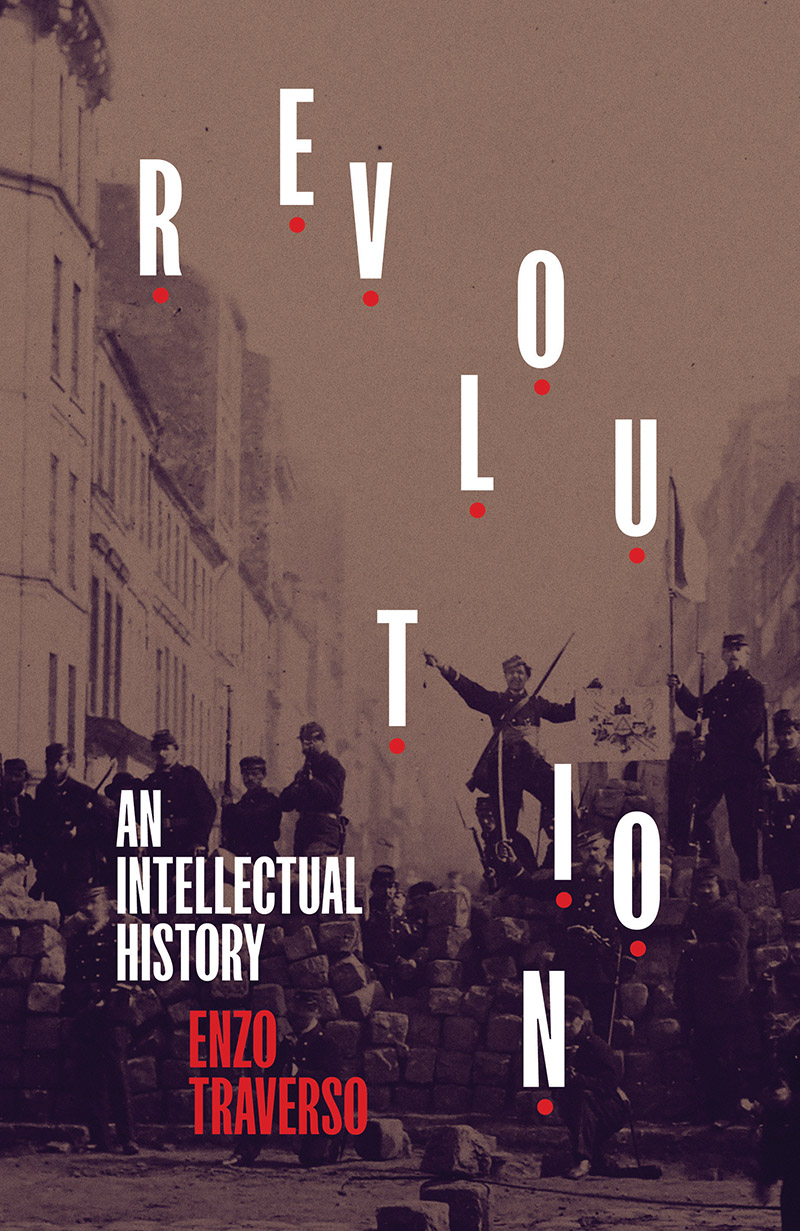
Memory is also a crucial site of struggle in Enzo Traverso’s Revolution: An Intellectual History, a text which sets out to make the revolutionary content of modernity accessible once again. For Traverso, revolution can be succinctly theorized as a ‘sudden – and almost always violent – interruption of the historical continuum’. Whereas classical Marxism retained an evolutionary theory of progress and belief in revolution as an inevitable outcome of capitalism’s crisis tendencies, Traverso emphasizes instead Marx’s political writing, in particular, its focus on history as the history of class struggle. Revolutions are not passively caused by objective historical laws but are consciously made by actors whose circumstances are nonetheless constrained by the structural determinations they seek to explode. As Traverso glosses, ‘revolution is the moment in which human beings make their own history; it is the moment in which the oppressed become subjects, turn the old social and political order upside down and replace it with a new one’. Reading Marx politically enables Traverso to conceptualize history as ‘a permanent process of [the] production of subjectivity’, a process in which agents are both subjected to forms of labour but also turn against that subjection, actively transforming themselves into new constellations of political sovereignty, collectivities that forcefully enter history and materially rewrite their destinies.
The situation confronting the twenty-first century left is different from its twentieth-century predecessor in two distinct but related ways. Throughout the twentieth-century, revolutionary victories and defeats, Traverso suggests, were conceptualized and given form as ‘military clashes’: armed battles against the amassed forces of reaction, imperial occupation, military coups. Defeats in the twenty-first century are no longer primarily inflicted by combat units but rather by the ongoing process of universal commodity reification. The example provided in Revolution is Vietnam, whose heroic anti-colonial triumphs against French and US imperialism have spiralled into post-colonial defeats, as the nation-state is disciplined and integrated into the world market. ‘Capitalism has won’, Traverso writes, ‘because it has succeeded in shaping our lives and our mental habits, because it has succeeded in imposing itself as an anthropological model, a “way of life”’. Such a re-coding of social being has infiltrated the otherwise impressive remobilization of unrest by movements which foreground, to varying degrees, the critique of capitalism. No longer prisoners to the vanguard party, with its inclination to treat workers as objects in need of direction, groups like Occupy Wall Street, self-organize from below. However, bereft of the memory of previous class struggles, these anti-capitalist orientations ‘do not possess the strength of the movements that, conscious of having a history and committed to inscribing their action in a powerful historical tendency, embodied a political tradition’. That is to say, they are unable to estrange and denaturalize the anthropology of capital.
The task, then, is to ‘work through’ the experiences of the Left’s political ‘ancestors’, to elaborate their unrealized hopes and reawaken the future pasts of that tradition in the present. Both as theory and history, revolution should not, Traverso argues, be presented as developing inexorably along linear trajectories. Revolutions are discontinuous cuts into time, dislocated breaks which are incorporated into the text’s formal exposition. Citing the theory of dialectical images that powerfully influenced Walter Benjamin’s historical method, Revolution is composed through a montage of images, ideas, concepts, figures, dreams, and longings – combining affects with action, feelings with theorizing. Like the ragpickers beloved of Benjamin and Baudelaire, Traverso sifts through the debris of modernity’s barricades, piecing together a kaleidoscopic array of themes and forms, encompassing locomotives, collective bodies, symbols, intellectuals and communist actualities. In this regard, Traverso’s book is not only revolutionary in terms of the content it makes accessible to thought, but also in its form: its gathered fragments interrupt the onward chronological flow of homogeneous empty time. Capital’s anthropological stranglehold is broken not so much by rewriting past defeats but by rescuing those thwarted aspirations from oblivion. The theorist, it turns outs, is a salvager too, a figure who scours all that has been left unfinished and sets it into dialectical tension with the present. By giving ‘new life’ to these revolutionary desires, political subjects can set about exploding the continuum of history.
Attuned to moments of bifurcation and periods of non-synchronicity, the intellectual history of revolution offered by Traverso has some resonance with the historical novel, a literary genre that is also revolutionary in terms of its form and content. The classical historical novel, as theorized by Lukács, represents the necessary dis-articulation of feudal social relations and the emergence of the bourgeoisie as a subject of history. Geographically contiguous ‘alongsides’ are reconstituted as historical ‘before-and-afters’, whilst romance, poetry, and honour are annihilated by the secularized prose of everyday life, by the de-personalization of domination. The historical novel instantiates a formal revolution as it decentres world-historical figures and foregrounds instead the mediocre hero, whose inscription into plebeian struggle makes history from below. For Lukács, the genre suffers a near terminal involution once it refuses to extend the bourgeois political revolution into a social one: the historical novel sides with a now hegemonic national bourgeoisie and mercilessly suppresses popular agitation. With the establishment of the nation-state as a political unit, history is believed to have been accomplished. In turn, the historical novel deteriorates into costume dramas, turning to antique and exotic settings which are no longer felt as the necessary prehistory of an open and unfolding present, annulling the form’s progressive historicism and replacing it with the perpetual present of capital.
The transformation from knowledge to spectacle has only accelerated with the annexation of ever-greater regions of social life by the commodity-form. If once the present was experienced – and represented by cultural texts – as the sequel and culmination of an almost Hegelian unfolding of historically ascendant social forms, it is now completely severed from any semblance of connection. As Frederic Jameson notes, the ‘organic genealogy of the bourgeois collective project’ – the subordination of provincial regions to administrative centres – has become ‘a vast collection of images, a multitudinous photographic simulacrum’. For Jameson, the historical referent has been obliterated and with the various defeats of the workers’ movement, the past no longer feels like the necessary precursor to the present. Instead, the historical novel of late capitalism, to use Jameson’s periodization, can only represent our ideas and stereotypes of that past. Realism dissolves into glossy pastiche. History, one of the characters in Thomas Pynchon’s V (1961) suggests, has folded in on its subjects, destroying any possibility of an Archimedean viewpoint or continuity with the past. Anticipating Jameson’s formulations, V contends that ‘we’ are entertained by period styles, fashions, atmospheres, attitudes and ‘are conned into a false memory, a phony nostalgia about what they were. We are accordingly lost to any sense of a continuous tradition’ – bourgeois and proletarian projects alike corrode in the aura of the image.
For the Jameson of Postmodernism, the way out of the impasse and blockage of memory is to outrage historical possibilities in the hopes that the shock of the false will convulsively reawaken an otherwise sedated historical consciousness. What remains of a realist impulse or referential drive, draws attention to a novel historical situation in which ‘we are condemned to seek History by way of our own pop images and simulacrum of that history, which itself remains forever out of reach’. Traverso’s project, on the other hand, is drawn less to a poetics of fabulation and more to the search for occluded revolutionary wishes, to the necromantic resuscitation of the ‘hopes of the vanquished’. Such a commitment to the recovery of dreams defeated by capital is shared by a tendency within contemporary historical novels, which sets out to re-inscribe the genre in the history of class struggle, in the production of subjectivities. These novels make perceptible the unfolding of social processes that constitute and destroy classes, that expropriate, absorb, and expel workers from processes of production and regimes of accumulation. Amitav Ghosh’s Ibis Trilogy (2008 – 2015), for example, rewrites the classical history novel in terms of the becoming black of the world, tracing the interconnected fate of a de-classed multitude who are entangled within the imperial networks that produce, circulate, and consume opium, a narco-epic shadowed by the colonial passage from slavery to indentured labour. Like other recent novels by Marlon James, Benjamin Myers, and Rachel Kushner, as well as the anarchist collective Wu Ming and Pynchon himself, Ghosh’s texts pivot on a biopolitical fracturing of humanity which violently ascribes social positions and identities. These contemporary historical novels depict the means through which productive subjects are both made by capital, but also how these subjects refuse and unmake subjection and capital too, passionately insisting that another world is possible.
 Thomas Travers