Broadly speaking, my research engages with cultural production, in particular the novel, through and alongside marxism and literary theory. Published peer-reviewed work is included below; click CV for additional public writing, and Projects for future research agendas.
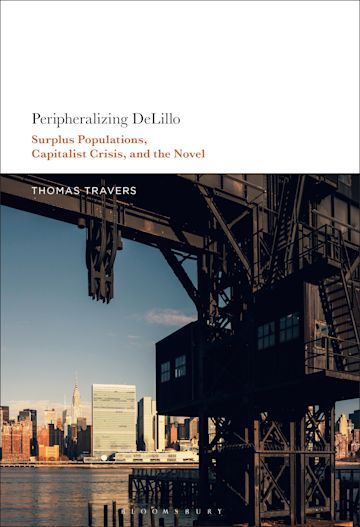
Peripheralizing DeLillo: Surplus Populations, Capitalist Crisis, and the Novel
Bloomsbury Academic, January 2022
Peripheralizing DeLillo tracks the historical arc of Don DeLillo’s poetics as it recomposes itself across the genres of short fiction, romance, the historical novel, and the philosophical novel of time.
Drawing on theories that capital, rather than the bourgeoisie, is the displaced subject of the novel, Thomas Travers investigates DeLillo’s representation of fully commodified social worlds and re-evaluates Marxist accounts of the novel and its philosophy of history. Deploying an innovative re-periodisation, Travers considers the evolution of DeLillo’s aesthetic forms as they register and encode one of the crises of contemporary historicity: the secular dynamics through which a society organised around waged work tends towards conditions of under- and unemployment.
Situating DeLillo within global histories of uneven and combined development, Travers explores how DeLillo’s treatment of capital and labour, affect and narration, reconfigures debates around realism and modernism. The DeLillo that emerges from this study is no longer an exemplary postmodern writer, but a composer of capitalist epics, a novelist drawn to peripheral zones of accumulation, zones of social death whose surplus populations his fiction strives to re-historicise, if not re-dialecticise as subjects of history.
Endorsements
‘Answering some big questions about the postmodern hypothesis from the ground zero of its ruin, this book sets out to reinvent DeLillo as a novelist of the anonymously dispossessed masses whose multitude defines our historical present. The DeLillo that emerges from these pages is less the exemplar of postmodernism in fiction than he is a prophet of dissent, a prescient thinker and artist whose writings conjoin the dominant characterological tendency of literary fiction since the 1960s with the social antagonism we are now seeing on the streets, writing its own epic in the language of rage and fire.’
Mark Steven, Senior Lecturer in 20th and 21st Century Literature, University of Exeter, UK, and editior of Understanding Marx, Understanding Modernism
‘Providing us with a startling new reading of Don DeLillo’s oeuvre, from his very earliest short stories to his late minimalism, Thomas Travers’ book is, however, far more than simply a great study of one of the most important U.S. novelists of our time. It is also one of the most significant books on Marxist literary theory and on the contemporary novel’s responses to economic crisis, financialization and the dynamics of dispossession that has been published this century. A major advance in our understanding of the novel’s attempts to grapple with the challenges to representation posed by contemporary capitalism’.
David Cunningham, Professor of Modern and Contemporary Literature, University of Westminster, UK
‘DeLillo is not the archetypal postmodern novelist we believed him to be, but an epic poet of the dispossessed, cartographer of the surplus populations thrown off by the
Daniel Hartley, Assistant Professor in World Literatures, Durham University, UK
“long downturn”, his fictions striving to re-historicize capitalism’s cast-offs as emergent subjects of History: such is Travers’ original and compelling thesis. The
book effects a wholesale reconceptualisation of the Jamesonian problematic of postmodernism, rewriting the relation of politics and form for the era of secular
stagnation via Deleuze and Guattari’s untapped notion of peripheralization: it is a critical triumph and a superlative work of Marxist literary theory.’

‘The Power To Burnish and Renew’: Porno-Accumulation, Fascism, and Surplus Populations in Don DeLillo’s Running Dog
Textual Practice, Fall 2021
Don DeLillo’s conspiracy novels Players, Running Dog, and The Names respond to, and imaginatively frame, what Giovanni Arrighi calls the ‘signal crisis’ of US hegemony. Despite mapping the spatio-temporal unfolding of US capital as it financialises accumulation, commodifies visual attention, and imposes neo-colonial economic reforms on ‘underdeveloped’ nations, Marxist critics have dismissed DeLillo’s pastiche thrillers as politically disappointing texts ‘constrained’ by an inability to supply alternative models of reality. In contrast, this article argues that DeLillo’s so-called formal defeats register a ‘discord’ between history and its conceptualisation, an enigma related to their discovery of ‘edge zones of modernity’. Drawing on ideas of historical lateness, the article re-situates DeLillo’s poetics through the optics of uneven and combined development, reflecting on the significance of surplus populations – both for DeLillo’s off-kilter conspiracies but also contemporary Marxist political economy. The article offers a close reading of Running Dog, a porno-political caper in which non-synchronicity manifests itself through the appearance of an object, perhaps the object: an adult film starring Hitler. Running Dog juxtaposes commodity frontiers based on violent appropriation with frontiers of immiseration where labour-power has been exiled from social reproduction altogether. In doing so, DeLillo refunctions romance into a genre of secular stagnation.
 Thomas Travers