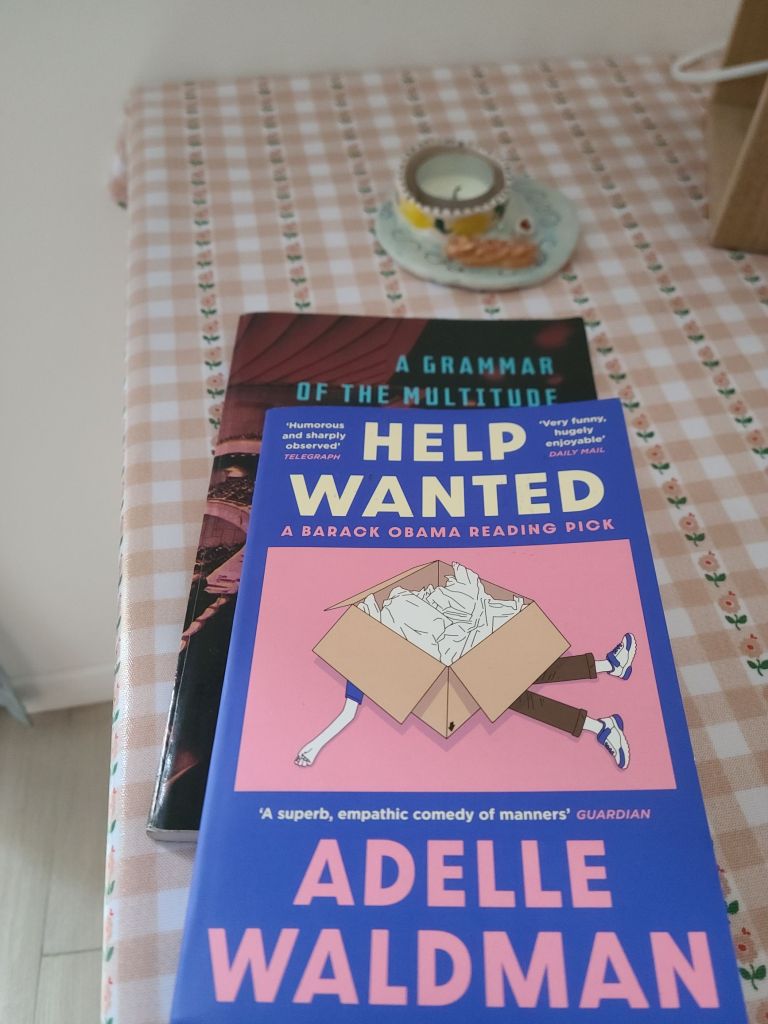
Adelle Waldman’s comic novel Help Wanted (2024) contributes to a renewed cultural interest in mapping the material conditions and intimate experiences of contemporary labor. As other commentators have noted, much of this (re)turn to work has prioritized the office, and is populated by mental or brain workers, characters who are hooked up to the demands of the knowledge economy and feed the creative drives of semio-capitalism with their ideas. Help Wanted, in contrast, is concerned with life at the other end of the labor market. Uniformed in beige slacks, the blue collars the employees of Help Wanted wear correspond not to industrial manufacturing but the tertiary retail sector, and a workforce who try to piece a life together out of multiple low-paid, part-time contracts. Rather than struggle to shorten the working day, one of the historic demands of the labor movement, Help Wanted profiles workers who fight for extra hours, who push to extend their shifts so as to earn enough to reproduce their lives.
Help Wanted also distinguishes itself from other recent depictions of the fragmented experience of precarious labor through a commitment to recording something like the collective dimension of work. For the late Paolo Virno, the labor process has been subsumed by ‘virtuosity’, where the performance of an activity does not settle into a ‘finished product’ or ‘an object which would survive the performance’. Virtuosity characterizes much of the emotional or affective labor prevalent today, where workers do not produce a product but rather an experience, a feeling, a mood or vibe. At the level of cultural representation, it is not uncommon to see virtuosity conflated with the virtuoso, the unusually talented individual who is a gifted reader of social relations. Help Wanted refuses to submit to this formal hierarchy and is marked by a determination to register the ‘emotional tonalities’ of the multitude through a multiplicity of perspectives. The novel does not coalesce around one privileged actor or voice, but draws on a distributed and decentered narrative framework, enacting a democratic belief in the equality of perspectives – one which breaks with the staged listening exercises of management.
Set against the spectacular backdrop of the Catskills, Help Wanted follows the employees of the fictional ‘Potterstown’ branch of the equally fictional mega-retailer ‘Town Square’. Specializing in ‘mass-produced knockoffs of trendy, boutique items’, Town Square’s consumer base are people who ‘get a kick out of imagining they were shopping at a real discount store’ – a fantasy, its own staff cannot afford to share. When store #1512 opened in 2003, the corporate hierarchy envisaged that it would perform like a ‘traditional suburban market’; however, with the outsourcing of an IBM plant to Mexico, Potterstown has become a hinterland, a vector along which the secular decline of the US economy passes, revived only in the summer months as an attractive outdoors retreat for those escaping New York City. Hence the seasonal availability of hours for the team who belong to ‘Movement’, the logistically oriented division of Town Square who arrive at 04:00 am to unload the overnight delivery and punch out again at 08:00 am once the store has reopened.
Exploring the fallout of IBM’s departure from Potterstown is one of the ways in which Waldman’s novel attempts to historicize its relation to a present defined by neoliberal globalization. The legacy of the financial crash of 2008 is another example of how Help Wanted traces the effects of macro historical processes as they rebound on the daily lives and futures of ordinary citizens. As a company, ‘Town Square’ itself evokes a certain anachronistic charm, a nostalgic attachment to the fantasy of civic life conducted in person, in break and mortar stores. Under immense pressure from an online retailer not to be named in the novel, Town Square’s services and operations are undergoing a concrete version of ‘enshittification’, with standards sliding as the internet radically reconfigures consumer experience in an age of friction-free capital. The strains of competition are passed along to ‘Movement’, who are understaffed, offered reduced hours, and cheated out of benefits; whilst simultaneously subjected to increased surveillance and compelled to meet arbitrary performance metrics, times, and targets. With management no longer able to secure consent through bonuses, they turn to the only currency they have the left: the possibility of a promotion, an illusion they induce in employees through individualized affirmation and praise, by making the target feel valued, their rise destined.
For the team members who constitute ‘Movement’, these forces cohere into a shared structure of feeling marked by insecurity, indebtedness, anxiety, and disappointment. In their own individual ways, Nicole, Ruby, Diego, Val, Milo, Joyce, Travis, Raymond, and Callie feel both under-appreciated and thwarted in their current roles at Town Square but also entertain the dream that their lives could be substantially improved through work. Help Wanted is perceptive to the affective dimension of work, to its rapid alternation between hope and fear, to how previous encounters shape future actions, to a dialectic in which the dead-end job could mutate into an escape route – via corporate recognition. The novel is also at pains to not just simply dismiss the work of Movement as unskilled but captures the pleasures and masteries of a task afforded to individual characters. Ruby for example, folds clothes like a virtuoso, ‘with the speed and precision of a piano player’. Whilst several long-serving members of Movement keenly feel their potential atrophying, for others, like the ex-drug dealer Travis, the position represents a clean break, an opportunity to quit the paranoid hustle of the black market and to feel pride, rather than shame, in their relationship to society. With its ensemble cast, Help Wanted to able to excavate the psychic and emotional lives of an exemplary workforce and link these effects to material causes within the economy.
Like all good workplace dramas, Help Wanted is carried forward by a conspiracy from below; however, rather than covertly organize a union, the workers of Movement ‘plot’ to get a detested manager promoted. At the level of content, this stages a version of the many versus the one, the executive manager Meredith, who is the clueless subject of the plot and ‘reason for its being’. The story unfolds over a series of overnight shifts which are undertaken by Meredith and Movement in order to clean up the warehouse and simulate an appearance of order to impress the visiting hiring committee. Formally, this struggle is waged through a third-person narration which displaces any single point of view and pings around from mind to mind, often undercutting or recontextualizing previously stated assumptions. Waldman uses this unsettled narrative style to great comic effect, cutting back and forth, revealing profound differences between a character’s image of themselves and the perception an other has of them. To push the theme of performance, the novel aspires towards a symphonic quality, even if its conductor, Meredith, has absolutely no idea of the action she is orchestrating.
Yet if this multi-perspective form gestures towards a democratizing impulse that levels character and labor hierarchies, it also hits against a political impasse which Movement are not themselves able to resolve. In a ‘molar’ sense, Movement is an institution formed out of a collection of bodies who combine and collaborate on a shared project. At a ‘molecular’ level, the group is composed of individuals, each affected by their own personal desires and ambitions, always threatening to veer off from the mission. This is especially true for the collectively scripted plot to get Meredith promoted, which is understood as both a universal good but also a private opportunity to progress up the organizational ladder. That is to say, each team member is fully cognizant that a promotion for Meredith will generate a space in the corporate hierarchy which they could – and believe they should – occupy. The many thus work together but dream separately.
In the aftermath of the hiring decision, Nicole reflects that ‘having a common enemy had given their days shape […] work now felt kind of slack, dull’. The plot supplied the members of Movement with form, a hidden script, an anti-corporate myth in which their efforts mattered and were meaningful in themselves – the virtuoso labor of industrial sabotage. Once Movement return back to their previous routines, the feeling and experience of self-organized unity wanes, form becomes formless. It is tempting to suggest that whilst Help Wanted democratizes literary form it does not complete a formal revolution. The horizontalist multi-perspective narrative structure unifies the activities of the multitude into an emancipatory project, but it does so without changing their relationship to work or their relations to one another as workers. There is a multiplicity of voices; however, they are ultimately unable to transform themselves into something new, a collective voice from which a political subject might emerge. To do that, perhaps the members of Movement might need to join a union after all.
 Thomas Travers