In an era in which cultural production appears subordinate to the demands of intellectual property, with its preference for franchises, remakes, reboots, sequels, and prequels, it is perhaps not all that surprising that the ‘origin story’ has displaced the personal bio in explaining our interests, passions, and attachments. Encompassing everyday phenomena from sports fandom to political beliefs, origin stories re-present first encounters and foundational events, re-staging how we have become ourselves. On account of their proximity comic book multiverses, they might also be considered as another ‘meta-scene’ through which subjects are individuated and encouraged to interpret structural processes in terms of individual responsibilities and decisions.
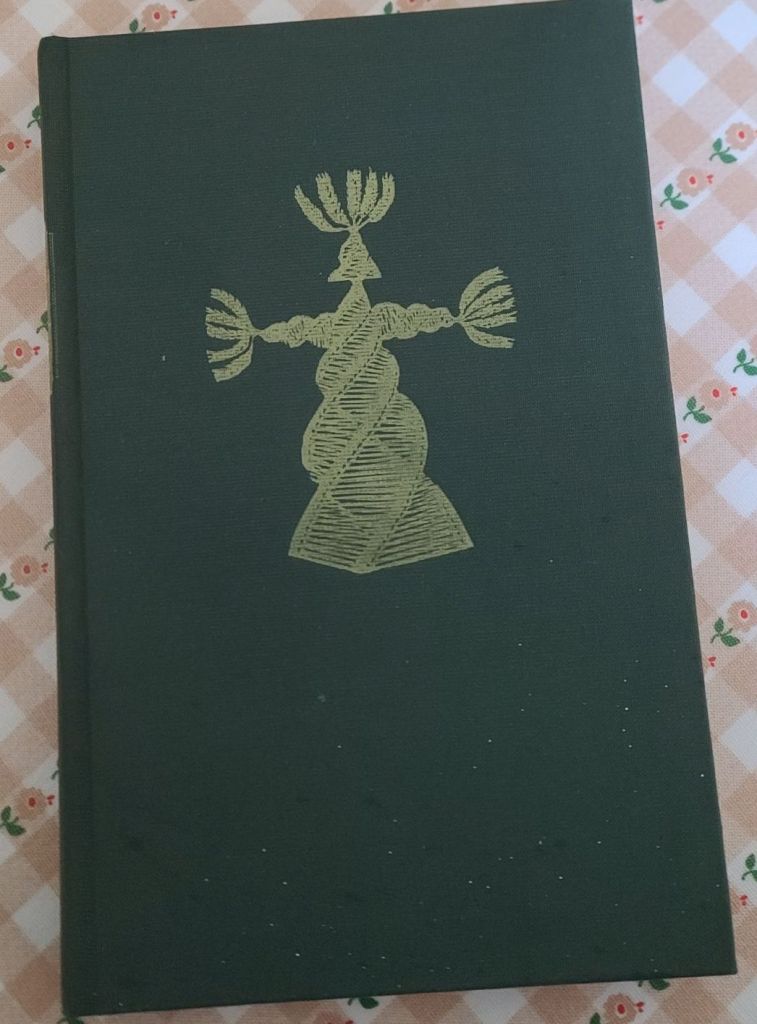
At other times, they might not even be our own stories, but the stories others tell us. Every so often, my dad likes to share with me his version of my ‘literary’ origin story. In this account, he returned from work one evening to find that I had busted out of my cot, grabbed hold of a fountain pen, and used folio society editions of novels as blotting paper. Is this the story of an avant-garde irreverence towards the pieties of the canon and experimentation with the materiality of the text? A democratizing disgust at the mid-brow transformation of literature into ornate spectacles of consumption? Or perhaps of an inclination towards criticism and its splotches of ink around another writer’s work?

One of the works affected by this affair of ink was a copy of Thomas Hardy’s Under the Greenwood Tree (1872), a text I assumed I would never read out of a pronounced ambivalence towards the above origin story. Under the Greenwood Tree is by no means an origin story; however, it provides readers with an early introduction to the fictional region of Wessex which will be the setting of Hardy’s later novels. Arranged around the passage of the seasons – from winter to autumn – Under the Greenwood Tree captures the scenes, rituals, and characters of a rural mode of life on the brink of dissolution. Attuned to the ‘direct pathway of Time’, the novel is torn between the emergence of the new and a residual affection for the ancient, a conflict that is encoded symbolically as the struggle of the many against the few.
The many, in Hardy’s novel, are not so much the democratic multitudes asserting their presence in literary form, but the vestigial traces of alternative bonds of community and kinship. More specifically, the many take the form of a band, a string choir – or ‘quire’ – composed of tranters, cobblers, tailors, and other tradespeople, skilled and unskilled, active or retired. A multi-generational collective, the choir is a type of self-organized folk institution, one which preserves the memory of popular traditions and maintains local customs in the parish of Mellstock. If Under the Greenwood Tree’s seasonal arrangement gestures to the difference between the temporal structure of life in the country versus the clockwise passage of time in the city, it also introjects the reader into this ‘pre-industrial’ form of living. The novel opens on Christmas Eve, with the players gathering for cider before setting off across the parish, performing festive songs outside the homes of residents, whether welcome or not. Despite Hardy’s note that the depiction is ‘intended to be a fairly true picture’, the good-natured honesty of the choir feels more like an idealized fantasy of collective life undergoing its historically determined disbandment.
Figures of innocence and earthy common sense, the choir are not unaware of their anachronistic status, which is the subject of melancholic introspection. ‘Times have changed from the times they used to be’, one member reflects, ‘people don’t care much about us now […] we must almost be the last left in the country’. Pressure from beyond the parish boundaries comes in the form of innovative technologies and instruments, such as the barrel organ, which replaces the collective with the one, who, uncharitably, is an appendage to the machine. Changing cultural tastes are also attributed as precipitating a decline in popularity of string choirs. Whereas the old violins are associated with ‘simpler notes’, the new is instantiated in the ‘crowded chords’ of organ music, in a style of playing whose bulky complexity manifests the spatial density of the urban and its urgent transformation of time.
Yet the choir’s position is more immediately threatened by developments within the parish itself, by the appearance of the new schoolteacher, Fancy Day. An outsider whose looks and conduct break with traditional values, Fancy is courted by several prominent members of parish society, including its wealthiest farmer and the vicar, who plot to remove the string choir and replace them with Fancy’s organ playing. Sociologically, the few are elevated in terms of their relative class position, as landowners and clergy, but they are also differentiated discursively as distinct personalities through their involvement in the romance plot, which prioritizes private intrigue and pushes the communal dimension of life into the background.
The struggle between the many and the few is staged indirectly through the contrast between scenic descriptions which aim to document the behaviors and idiosyncrasies of rural life, and the marriage plot, which seeks to transform the disequilibrium caused by Fancy’s arrival into a new order. At the level of content, this battle takes place through who will have the right to perform during the Sunday church service. Part two ends with the defeat of the choir, who agree to give way to Fancy; a defeat that is enacted formally through their disappearance from the narrative, which transitions entirely towards courtship and suitors, to the strategies of the heart. When the choir reappears, it does so as a broken ‘body’, ‘scattered’ among the church pews, its former members feel ‘awkward, out of place, abashed, and inconvenienced by their hands’. No longer ‘conducting the service’ with their music, the many continue to reproduce the ethical life of the church but have been stripped of their capacity to shape and contour the tone of that life, passively consuming its injunctions and no longer active participants in creating a world.
These two plots are mediated by the handsome but naive Richard ‘Dick’ Dewy. A member of the choir, Dick begins to differentiate himself from the many and script his way into the few through a seemingly quixotic pursuit of Fancy. From the perspective of his friends, Dick is trapped in a regrettable folly: courting a woman is who is not only superior to him socially – he is the son of a tranter with limited financial prospects – but whose education, refinement, and forward fashion sense stands in sharp contrast to Dick’s plain simplicity. Fancy has a self-confessed attraction to attention and enjoys the feeling of being desired. These voices of concern are nonetheless overwhelmed by Dick’s single-mindedness, which drives the novel towards affect rather than ethnography, to an exploration of how the ‘heart’ influences the ‘brain’ – ‘which is always the way to manage people’, Fancy notes.
Rooted in the environment, Under the Greenwood Tree reads now like a nostalgic re-imagining of rural life, a homage to communal bonds prior to their violent dissociation under the forces of modernity. But these characters also seem like oddities or specimens curated for a metropolitan audience who already inhabit the now. The split between the standard language third-person narration and use of regional dialect for reported speech, enacts a comic othering of these unworldly figures, who retain their claim to innocence for having never left Eden. This sense of belonging to another, possibly nobler time is also evoked through a structure of feeling which unites the community and sets it in opposition to the impersonal abstractions of the market. For instance, we are informed that Mr. Penny, a cobbler, refuses to hang a sign outside his workshop as ‘advertising in any shape was scorned, and it would have been beneath his dignity to paint it up, for the benefit of strangers, the name of an establishment whose trade come solely by connection on personal respect’. The outlook of extinction and yet, given demands of semio-capitalism and the attention economy, an obduracy that I have some sympathy for.
Unlike many of Hardy’s later novels, Under the Greenwood Tree is a comedy rather than a tragedy, it resolves its contradiction through marriage, rather than death. Would be betrayals are reneged on and transformed into secrets that condition the possibility of happiness rather than truths that would obliterate life. There is a temptation to interpret Fancy Day as the embodiment of the new, of the frivolous and the vapid which will upend the immediacy of collective existence in Mellstock. At points there is certainly a gendered element to her characterization, in which culture can be duplicitous versus the romanticized transparency of Dick Dewy. Here, perhaps Fancy occupies the ‘Day’ which Pynchon’s anarchist revolutionaries fight to stave off in Against the Day. On the other hand, Fancy is a figure of dislocation, an outlier who wants to break from the patriarchal household and create a space for herself in the world. Her desires exceed the constraints that a rural class society would otherwise impose. A harbinger of the modern, Fancy is a dreamer: we rarely see her at work. What she fantasizes about is a world in which we have all escaped the fates that capital would like us to believe are pre-determined and inevitable.
 Thomas Travers