Several months ago, I listened to a podcast on Quinn Slobodian’s most recent book Hayek’s Bastards (2025), in which he referred to the scripts and narratives used to orientate oneself in the world as forming the ‘supply-side’ of political populism. Whilst the ‘demand-side’ considers the nebulous factors that lure voters towards populist figures, the ‘supply-side’, Slobodian explains, questions ‘what kind of language are they being offered to organize their resentment around’. What narrative hooks are being deployed to capture attention and how are these pre-existing feelings sequenced into a story that offers a compelling causal explanation as to why the world is so out of joint? In a recent episode of the London Review of Books podcast – (there is only so much Duolingo I can tolerate on the commute home) – Alan Finlayson advances a similar argument when surveying the power, at least rhetorically, of Nigel Farage’s latest electoral vehicle, Reform UK. Reform’s rhetoric preys on a pervasive mood of decline felt across British society, connecting personal and collective anxieties about the future direction of the country to immigration as a visible sign of change. And, like all good plots, Reform’s identifies a villain: the liberal elites, sequestered away in Westminster, who have not only deliberately brought about these changes, but they also hate the people and despise their way of life.
The attraction of flows of desires and beliefs, and their concatenation into convincing narratives is central to Yves Citton’s recently translated Mythocracy: How Stories Shape the World (2025). For Citton, the media situation described by Slobodian and Finlayson corresponds to an ascendant ‘right-wing imaginary’ which continues to arrange, integrate, and marshal a complex set of sensibilities, feelings, statistics, images, hopes, fears, demands, and reflexes into a potent and self-amplifying interpretation of the present. Such is its symbolic consistency and coherency that the stories promoted and pushed by this imaginary often pass as common sense: welfare services are stretched as a consequence of mass immigration, billionaires are job creators and therefore deities beyond reproach, only another round of austerity can assuage the bond markets. The challenge Mythocracy sets itself is to explore the power of narrative, to question the capacity of stories to affect political subjects, and to analyse the role of myth in both reiterating dominant grammars but also of its potential for reconfiguration too, its ability to dream and imagine the possibility of the world as otherwise.
In order to diagram the multiplier effect of stories, Citton first stakes out the ‘imaginary of power’. Given his own background as a professor of literature, it is perhaps unsurprising that Mythocracy distances itself from – but never diminishes – ‘hard power’, an articulation of power that relies on ‘prohibition, command, coercion’ and is typically linked to the exercise of violent force. Instead, Citton picks up on a rich seam of thought directed at ‘soft power’, a form of power which operates through ‘insinuation, suggestion, stimulation’. Rather than threaten and intimidate the body with batons, riot shields, and swat teams, soft power looks to occupy the mind, to take advantage of memories, inspire fantasies, nudge desires, and influence belief. Drawing on Michel Foucault, Citton emphasizes soft power’s talent for getting subjects to internalize how it wants them to behave: ‘it incites, it induces, it seduces’. Soft power could be said to ‘meta-conduct’ conduct; that is to say, it acts upon what a subject imagines they can do and cajoles the subjecting in to wanting to do what the subject wants. This is not a power ‘anybody holds, but something whose circulation constitutes us’: it is a current that passes through our bodies and brains and, where successful, channels our affects and intellects toward certain desired pathways.
One of the ways that soft power circulates through the social body is stories, which are both narrated by discourses and ‘scripted’. Scripting as an activity takes on a particular valence in Mythocracy and is keyed to the ways ‘in which narratives act on those who listen to them, watch them, or read them’. Stories, whether they are accounts related by friends, viral sensations on social media feeds, or prestige television, are never simply passively consumed, no matter how mindless the content can seem. A story, Citton writes, ‘always functions like a prompter: a stimulator of action, a trigger, a driver’. Making use of ‘metalepsis’, a term borrowed from narratology to describe a breach between different levels of discourse, Citton is especially interested in the frontier or border zone between fictional scenarios and the facilitation of action in the real. In other words, there is a relay between fictional texts and the concrete instantiation of previously imagined acts (as an aside, Nathan Fielder’s Rehearsal could be said to push this logic to its neurotic limits). Scripting, then, refers ‘to the inscription of a narrative effort within the transformations it is oriented towards inducing in reality: this takes place through the metaleptic force that transmutes the behaviour of imagined characters into the behaviour of real people, as the narrative experience clears a path for their future actual conduct’.
From here it is possible to differentiate between three levels of scripting. First, there are the scripts we write for ourselves as we pursue our own goals. Second, there are the ‘counter-scripts’ we write in response to narratives that we wish to block or obstruct, be they xenophobic, transphobic, or authoritarian. Thirdly, there are the meta-scripts we use to script the actions of others as if they were their own; or, more unnervingly, which are scripting our actions, conduct, and beliefs. To help stage these different orders of scripting, Citton turns to an episode from Denis Diderot’s eighteenth-century novel, Jacques the Fatalist and his Master (1785), which concerns a spurned women who takes her revenge on the libertine who abandoned her by meta-scripting his marriage to a former whore. Whilst the Marquis scripts his appearance, attitude, and gestures in order to seduce who he believes to be a pious, but exploitable, women, his conduct has actually been meta-scripted by the scorned Madame de La Pommeraye, who has recruited the Marquis’s new target of affection and written the entire scenario. As ‘soft power consists in making others act of their own free will’, scripting, Citton notes, ‘transforms every act into a gesture’ designed to ‘modulate appearances so as to produce the hints and prompts that will lead the other person to do what we want them to do’. Meta-scripts themselves become a sort of structural determinant meta-conducting our conduct: whose myth are you?
Meta-scripting the action of others so that they align with their own objectives is a significant feature of many of the fictions of outlaw appropriation that have appeared on this blog. With its mantra of acting on the intellect, attracting attention and modifying memory in order to influence future acts, soft power certainly seems to fall within the ambit of the confidence man and woman, the con artist, the hustler, figures who use storytelling to stimulate fantasies so as to move the minds, bodies, and most importantly, the money of their marks, in a favourable direction. Alternatively, a film like The Sting,with its grifter auteurs, updates Citton’s enlightenment example, with an elaborate meta-script in which both mafia gangsters and corrupt police officers are deceived alike (who, as institutions of hard power, are despised as hostile to forms of free association). Moreover, it could be argued that for Ricardo Piglia, money ‘meta-scripts’ outlaw appropriation in the first place, fanning dreams of riches to come whilst inducing outlaws into action, activities that frequently deal in stories.
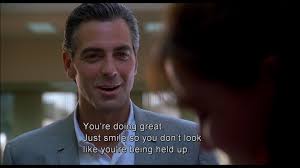
Yet the trace of scripting can also be detected in sub-genres that might otherwise be assumed to be the preserve of hard power, such as the bank heist. To be sure, the heist is rarely pulled off by muscle alone: more often than not, it requires elaborate planning, the work of conception, immaterial or mental labour. And perhaps it could also be argued that a conceptual heist film like Christopher Nolan’s Inception outrages the distinction between hard and soft power altogether, as it forcefully breaks into someone’s mind in order to plant (incept) the idea that the target will believe is their own. Then there is the case of Robert Redford’s ‘gentleman’ robber in The Old Man and the Gun, who sticks up banks simply with his genial smile and charming manners. Though maybe the most stunning example of meta-scripting can be sourced in Steven Soderbergh’s Out of Sight, where an unarmed George Clooney pulls off a bank job based on the strength of his pitch, his words. Clooney’s character meta-scripts a bank teller into a scenario where ordinary objects, such as a stranger’s briefcase, are explosive props within an elaborate scheme, prompting the teller to act according to Clooney’s wishes, without any show of force. Out of Sight explores the ways in which the scripts that meta-script our conduct, such as how we perceive situations depending on the way they are framed, the mise-en-scene, can be appropriated by talented readers, whose only weapon is language itself.
The meta-scripts that govern our conduct can take on everyday forms too, such as the myth that with enough aspirational striving, one can work their way into generational riches. To tip my hand, Erik Baker’s erudite Make Your Own Job (2025) argues that the entrepreneurial work ethic is one such script which feds into the imaginary of the American workforce, one that simultaneously promises to emancipate workers from the wage whilst devouring their bodily and mental well-being. For Mythocracy, the ‘infrapolitics’ of myths resides in the ways their plots ‘re-iterate’ pre-existing grammars, expectations, and arguments, or ‘reconfigure’ them, introducing unexpected sequences, bizarre syntaxes, and novel perceptions around which new mythic forms could coalesce. The difference between plots that lead our desires, beliefs, and hopes down well-worn paths, or those that start to push our attention and affective investments towards different routes and institutions. The primary task of any emergent left-wing imaginary, Citton concludes, is to disqualify the presupposition of the given, to break with its framing of the world and to open up a space for dreams of different days, virtualities that can only be actualized through our collective effort to transform the world.
 Thomas Travers