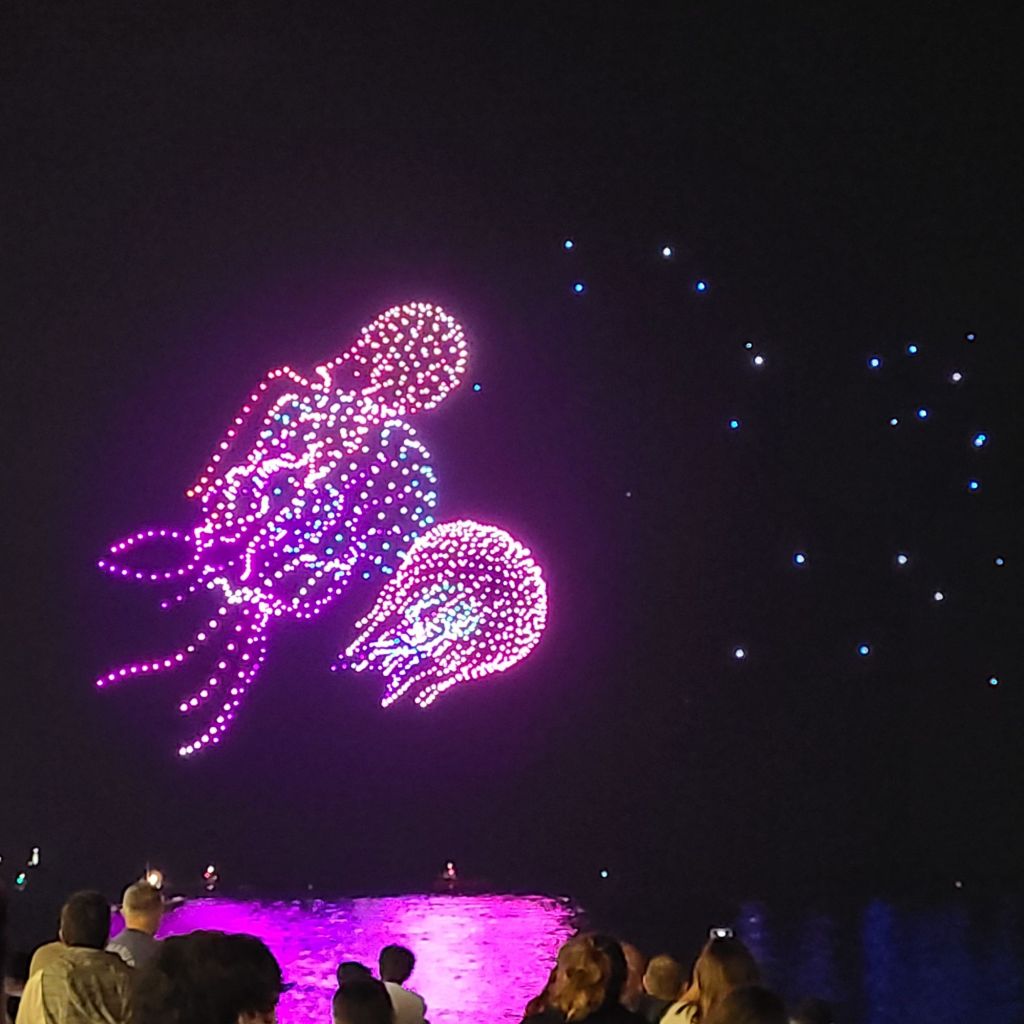
For the past year I have been working (in an administrative capacity) for an ocean science master’s program based on the Cote d’Azur. Amongst many unexpected scenarios, the job has also provided me with a crash course in a set of concepts, practices, and terminology that at times has felt otherworldly: what exactly is a dinoflagellate again? Or a cnidarian for that matter? When did we start referring to orcas, seals, and sea turtles as marine megafauna? As a consequence of being newly exposed to the efflorescence of life forms that exist in the oceans, I have found myself more readily disposed to marine related content, whether it is articles about the nascent octopus fishing industry off the warming coastal waters of the UK, or mindlessly consuming the cursed byproducts of Hollywood franchises like the Meg. Two of the central threads running through the program, conservation and innovation, are brought into dialectical tension in Richard Powers’s subdued novel Playground (2024). Juxtaposing the deep histories of marine organisms and the lightening-paced temporal acceleration associated with the techno-infrastructure of Silicon Valley’s cloud capital, Playground explores the cultural, ecological, and political affordances of the blue economy.
The ocean presents a formal challenge to narrative structures typically wired for evaluating progress and linear development. ‘The open sea was a calendar consisting of one blank page’, a character reflects, ‘out of sight of land, human time vanished and human geography with it’. Playground approaches the watery immensity of the ‘Earth’s relentless engine’ through four privileged points of view: the tech-billionaire Todd Keane, Todd’s childhood friend and underemployed educator Rafi Young, Rafi’s partner, the Tahitian American artist Ina Aroita, and the pioneering Canadian diver and marine explorer Evelyne Beaulieu. Resembling the ocean currents themselves, these narratives circle into the present, gathering lifetimes worth of emotional detritus and the collateral damage of ambitions (thwarted and realised), spiraling towards a reckoning on the island of Makatea, part of the Tuamotu Archipelago in French Polynesia.
On one level, Playground is the story of a friendship between two gamers, one white, one black, like the stones from their beloved Go. Despite growing up on opposite sides of the racial and class divide in Chicago, Todd and Rafi bond over a shared obsession with games. Roommates throughout college, their paths eventually bifurcate as Todd is drawn to the emergent possibilities of information-based technologies, whilst Rafi harbors a residual attachment to literature, humanistic education, and print media. Rather than characterize a certain relationship to the ocean, the novel actually derives its name from the social media platform founded by Todd and the source of his exorbitant wealth. In this regard, ‘playground’ the platform belongs to a new ecology of attention and its success resides precisely in its ability to ‘gamify’ social interactions – an idea Todd borrows from Rafi, which in turns precipitates their estrangement. Play, the novel suggests, has moved from a discrete field of human activity and now organizes much of our social encounters and engagements, contributing to the complete monetization of human experience. No longer on the cultural margins, ‘games now ruled humanity’.
What might be described as the gamification of existence extends its tendrils into the act of cultural creation itself. For an ardent techno-enthusiast like Todd, the automation of storytelling through the use of generative artificial intelligence can be imagined in terms of play, with the pattern of words in a narrative resembling nothing so much as the placement of stones on a Go board. As Todd addresses the latest version of AI: ‘all you do is look for the next best stone to add to the sequence of beautiful moves that you are unfolding’. Having consumed ‘everything we ever said and did and wrote and believed’, AI, Todd concludes, is in a position to play with humanity, to supply it with fantasies of closure – a game that Playground might also be having with the reader.
But Playground is also a story about the histories of colonialism and cycles of colonial extraction. Whilst characters like Rafi and Ina are drawn to the forms of life on Makatea because of their discontinuities with the present, the island itself played a crucial role in the emergence of that present too. Early in the novel, the narrator provides a succinct overview of the geological history of the island, a formation that left Makatea rich in deposits of phosphate, a key compound for crop fertilizer. Discovery of the ‘magic rock’ in 1896 and the arrival of a joint venture company in 1911 fundamentally transform the island, altering its rich environment into a ‘moonscape’ and unleashing the dialectic of modernity, whereby advances such as electricity jostle with public health crises from contaminated water. As the narrator glosses, there is an unequal exchange between core and periphery: ‘the course of civilization is written in water. And some time great cities owe their existence to tiny ocean islands. For a while, Makatea fed millions’. The novel pushes this argument further and directly links the extraction of phosphates to ideas of overshoot and worsening metabolic rifts: ‘Makatea helped Homo sapiens subdue the Earth’. For the narrator at least, the geology of Makatea has enabled humanity to become the geological agent of the Anthropocene.
The neo-colonial scenario depicted in the present of the novel concerns a proposed ‘seasteading’ project. Broadly coeval with the network state movement, seasteading is one of the libertarian fantasies of escape incubated by Silicon Valley’s billionaires. Owing to its location, Makatea has been identified as the ideal site to build a proof of concept factory which would assemble modular parts for these floating cities, cities which would float free from national sovereignty and democratic accountability. The derelict and dormant infrastructure of the phosphate mining industry would thus be reawakened, re-coded, and re-territorialized by the seasteaders, bringing jobs and prosperity to Makatea once again.
First, however, the project must be approved politically, which allows Playground to extend beyond its four ‘North American’ inflected characters and engage, albeit briefly, with the lives and livelihoods of the other residents of Makatea. To an extent, the novel sets out to stage the processes, rhythms, and rituals of local, citizen-led democracy, drawing on town halls, councils, and dances. Predictably, the community splits into two opposing camps. On one side, there are those impressed by the chance to re-stimulate the economy and the opportunity to onshore essential services and amenities. On the other, there are those who would rather Makatea remains ‘forgotten’ to the world, who emphasize the recovery of ecosystems after the ravages of the phosphate extraction. The tension between progress and sustainable conservation is foregrounded during a discussion of the fate of the coral reefs which ring the island, and which would be casualties of the seasteading operation. Abundant in biodiversity, the reefs provide sustenance to local small-scale fishers but also have a value that seemingly exceeds the economic. Indeed, the potential destruction of the marine habitat prompts some to question whether the franchise should be extended to include all species that would be affected by the proposals, raising questions about what rights can be afforded to non-human life forms.
To be sure, the new is not always identical with progress in Playground. Whilst there is a stream that is clearly absorbed by the technological surges which are remaking human subjectivity, there is a counter-version of non-human intelligences established through the extraordinary career of Evelyne Beaulieu. If Todd Keane represents the capturing of attention, the automation of intelligence, and the enclosure of information, Evelyne stands in as a popularizer of scientific knowledge and advocate for the aleatory beauty of the oceans. An ocean scientist and early adopter of the aqualung, Evie, like Todd, is involved in opening up previously unknown regions of the planet to human understanding. Yet whereas Todd pursues data for profit, for Evelyne, the language of marine science veers between scientific specificity and an exhilarating release from habituated perception: ‘at times she treaded in place, swarmed by the wildest assortment of Dr Seuss creations – indigo, orange, silver, every color in the spectrum from piebald nudibranchs to bright, bone-white snails sporting forests of spines […] She was a powerless angel hovering above a metropolis built by billions of architects almost too small to see. At night, with underwater lights, when the coral polyps came out to feed, the reef boiled over with surreal purpose, a billion different psychedelic missions, all dependent on each other’. The other side of scientific empiricism is something like wild sensory agitation. Indeed, for Evie, her last wish is ‘to give the smallest hint of the creatures so varied and inventive and otherworldly that they might compel humility and stop human progress in its track with owe’.
The question of whether there can be non-destructive relays between the oceans and human innovation shapes ongoing scientific research informed by ideas of bio-inspiration and biomimicry. Playground provides an example of such a transfer through the complex ‘wild color’ dance of the cuttlefish, which provides the closing scene for Evie’s bestselling children’s book Clearly it is Ocean. For Evie, the cuttlefish’s moving, enigmatic and indecipherable performance is a fitting tribute to the fundamental otherness of the oceans, an ‘unfathomable’ beauty that must be protected. As a reader, Todd is both enraptured by what appears to be a sacred act, but also senses a pattern and familiarity. The flashing sequence and combination of colors and movements resembles the tempo and gestures of a gaming device Todd receives one Christmas, one that demands its users memorize and re-enact a sequence of moves. Here too, the pulsating inscrutable dance of the cuttlefish is commodified and transformed into a game training its users to behave in particular ways.
Ostensibly Playground is interested in the soft power of stories, the myths that circulate through us, which orientate our understanding of the world and set our desires in motion. Creation myths jostle with AI hallucinations, sculptures made from washed up plastics with the legacy of social media platforms. Yet for all its expansive themes, the novel feels surprisingly narrow, itself a kind of atoll. The account provided of the forms and structures that underpin Silicon Valley – and which are intent on remaking social life, globally – seems overly abridged and derivative – (see Halt and Catch Fire). At the same time, the novel seamlessly integrates the language of marine science and through Evie’s long life, evokes the development of the science, situating it in the context of the Cold War. Personally, the novel felt devoid of any meaningful antagonism. In part this can be attributed to the fact that it is only Todd, the billionaire in declining health, is afforded a first-person viewpoint, whilst the other voices drift into the same indistinct tone. The role of humanistic education and art is dialed down, an aspect that is initially a surprise until one of the narrative conceits is revealed. Put charitably, the novel becomes an exploration of the self-enclosed worlds we are in the process of creating for ourselves, where we are only exposed to our particular fantasies on demand, where others are simply scraps of code, citations, memories, and images that can be endless reworked, reconfigured and recombined to appease our longings and pacify disquiet. It is a novel where the dead are resurrected and the feeling of closure can be simulated – all the while, the oceans warm, species die off, and capital turns to the frontier beneath the waves.
 Thomas Travers