In Mute Compulsion (2023), Soren Mau questions how capital has managed to ‘sustain its grip on social life’, how, despite its catastrophic volatility, it has been able to persist from the 15th century through to the present. Critics on the left have generally theorized capitalism’s continuity through a combination of violence and ideology – and their various spin-offs: coercion and consent, hard and soft power. Despite their differing emphases on what bodies are forced to do and how minds are shaped, theories of coercive and ideological power similarly conceptualize capital’s pernicious longevity through its direct address to subjects – its forms of interpellation. For Mau, such theories regrettable obscure a third form of power, one that is enforced impersonally, through what Marx calls ‘the mute compulsion of economic relations’. Economic power refers to ‘the ability to reconfigure the material conditions of social reproduction’ and, as such, reproduces social domination indirectly, by inscribing itself into the environment of those subjected to its forms. Evocatively, capital is said to have inserted itself as the sole mediator between life and its conditions of actualization, that it has injected itself into the human metabolism, making the reproduction of capital inextricably bound up with the reproduction of life itself. The ‘silent, unremitting pressure’ of economic relations thus preys on and puts to work the separation of proletarians from their means of existence – relations which do not necessarily require any specific apparatus of belief to remain operative. Intercalated with the relations connecting life to its material conditions, proletarian striving renews capital accumulation regardless of the feelings one may harbor about the economy.
One of the broad appeals of outlaw literature, I would want to suggest, is that whilst it by no means enacts the opposite movement – something like the communizing abolition of separation – it does dramatize the transformation of workers into subjects no longer beholden to the wage form and, by extension, its mute compulsion. By virtue of their refusal to diligently return to the factory, office, or household, the (anti-)heroes of outlaw literature foreground and make perceptible the pressures and frustrations of everyday existence under capitalism, engaging in acts, actions, and activities which in turn see them suppressed politically – they are outlaws after all. Outlaw cultural texts arguably instantiate a counter-poetics of sorts, combining gestures and ideas into forms that actively militate against the otherwise silent and unremitting pressure of economic relations: they do not stick to the script.
An alternative way of putting this, again with a nod to a recent work of theory, would be to propose that as a genre, the dominant theme of outlaw literature and cinema is ‘non-reproduction’, as Chantal Jaquet might say. Whereas Mau details the structural mechanisms through which proletarians are infernally turned into workers and back into proletarians again, Jaquet draws attention to narratives where this seamless reproduction of domination breaks down and where figures are able to escape the class assigned to them. Outlaws too seek to flee their social destiny but rather than cultivate the sensibilities and credentials of the bourgeoisie, they exploit the power of the false and contest relations of dominance – refusals that are not without their own political ambiguities and troubling identifications.
Or, to re-frame the problem yet again, and this time with reference to Jason Read and Yves Citton, outlaw texts interrogate the ‘power of scripting’. Read and Citton are interested in the power of stories: both in terms of the ‘imagination of power’ – the soft power that cajoles, courts, ‘insinuates, suggests, and stimulates’ – and the power of the imagination – storytelling and narration are presented as necessary preconditions of human action and the horizon which integrates these actions into a collective project. The particular activity of scripting emerges at the ‘point of encounter between practices of narration and apparatuses of power’, an activity that not only represents actions and establishes causal connections but also induces a ‘certain conduct of conduct’. For Citton, readers are not only affected by what they feel, hear, and see, but how these sensations are framed or placed in scene, affects their behavior, comportment, and what they imagine to be possible. The events, scenarios, and imaginaries that are presented and narrated in outlaw forms, arguably disrupt the pervasive atmosphere of obedience to capital, as theorized by Mau, and, at their most maximal, transforms how the readers of these texts interpret the world and their capacity to change it.
To relate this back to Ricardo Piglia’s account of outlaw appropriation, it is not that these outlaws circumvent economic compulsion entirely, but rather that they acquire a voice and gestural poetics denied the silent resentments of the waged worker. In Piglia’s view, the fiction of Roberto Arlt is exemplary in this regard: the law is broken, but rather than a straightforward delight in transgression, Arlt’s stories derive their surplus enjoyment from an almost obscene attachment to work by characters who are ostensibly repulsed by the bounded constraints of abstract labor. Crucially, Arlt’s characters do not earn money, they make it. Driven by the fables of lifestyles they will be able to enjoy once they have money, these characters turn storytelling into a form of work (they are both seduced by stories and fabricate seductive stories in a manner that would presumably dismay Peter Brooks). Arlt’s novels pick up on the bourgeois myth of making money through abstinence and hard graft and turn it into a fiction, producing money through alchemy, counterfeiting, chemical formulas, and blackmail. Piglia groups this cluster of activities under the concept of ‘imaginary labor’, of labor that works on the imagination but also sets the imagination to work. In an era characterized by grifters, hustlers, scammers, criminal lawyers and narco-entrepreneurs, the concept of ‘imaginary labor’ perhaps acquires renewed resonance. For Piglia, the concept is dialectical: whilst commodity fetishism erases the traces of social labor, the stories, frauds, and desires which combine into outlaw modes of appropriation re-assert the power of labor-power, establishing scenes of transformation, assembling forms of interaction in which individual and collectives imagine they have the capacity to alter their relationship to the material conditions of existence.
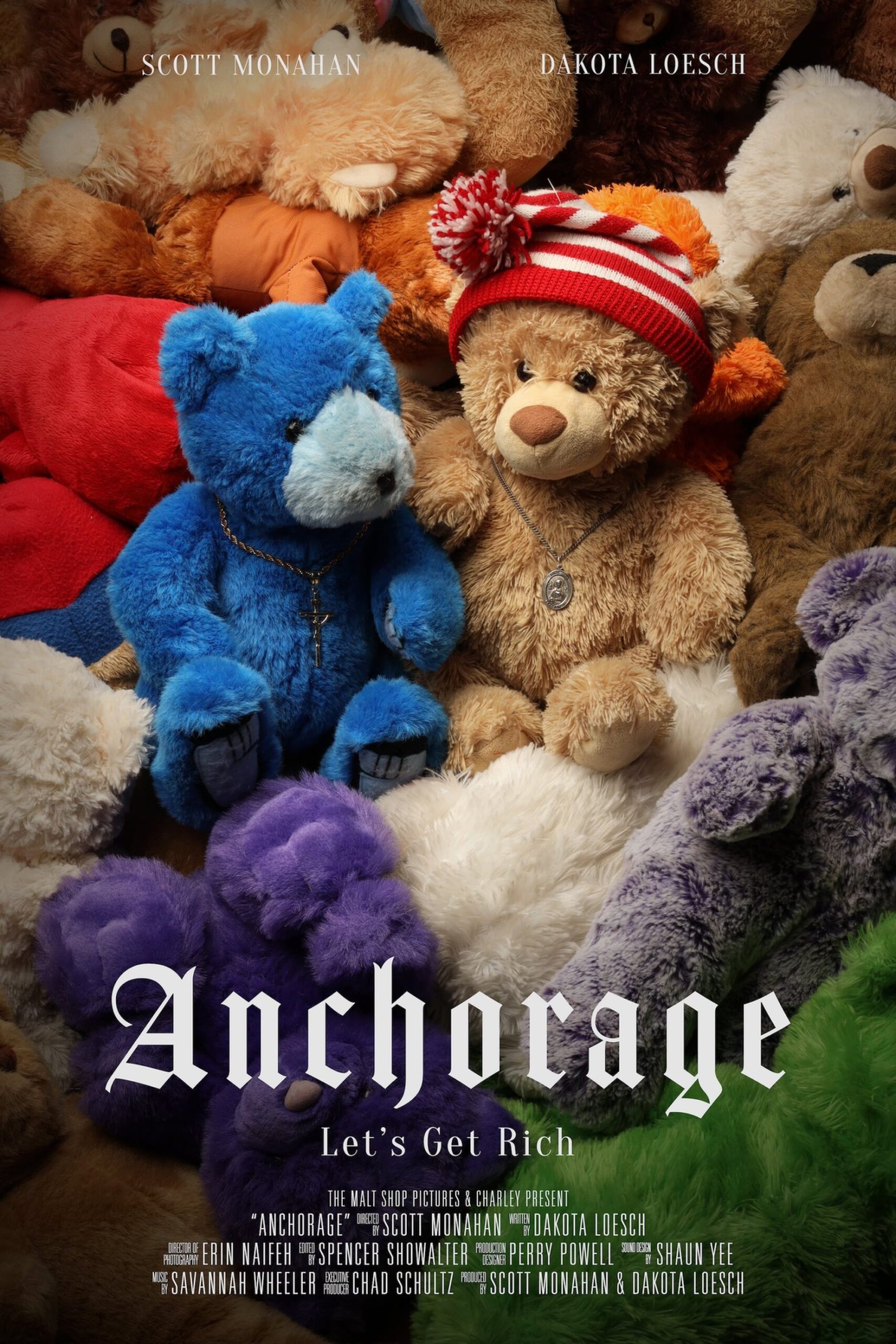
One recent example of a refusal to mutely reproduce conditions of immiseration is Anchorage (dir. Scott Monahan), a film which draws on Piglia’s claim that money is the cause and effect of literature and adapts it for the movies. Anchorage belongs to a trend of American outlaw cinema which take as its subject the collapse of the economic infrastructure that sustained the American Dream, a collapse Anchorage pursues through the putrefying core of the empire. Breaking with Piglia’s investment in the productive capacities of imaginary labor, the outlaws in Anchorage have already appropriated their contraband. Brothers Jacob and John open the film in possession of what they believe is a life altering quantity of drugs, a stockpile they (or the original possessors) have packaged into a trunk full of violently bright teddy bears. The brothers plan a route along the back roads from California to Anchorage, Alaska, where they intend to set up a trap house and strike gold on addiction and boredom. As John explains the scheme to Jacob, the value of the pills fluctuates depending on local contexts: if they set off for Los Angeles, as Jacob is inclined, the stash is worth next to nothing; in Anchorage, however, each pill is conservatively estimated to fetch a $100, a price that would comfortably transform them into millionaires. In this respect, Anchorage is less a movie about the manufacture of new goods and needs but of the circulation of commodities, bodies, and dreams: it is the fantasy about what the brothers might have once they are no longer shit poor that pushes them along their torturous journey north.
At the same time, whilst the film’s progression is spurred on by such daydreams of riches, money, at least in its cash form, is near entirely absent. Anchorage is fueled by the libidinal economy of what the brothers imagine they will obtain with money – scripts, performances, and habits they adapt from popular culture – but as a tangible object, is missing, present only as a remainder. Across the scenes and situations structuring the road trip, the viewer never sees the brothers engaging in cash transactions: they sleep overnight in abandoned properties and during the day shoplift supplies of food, drink, and gas. Money exists for John and Jacob in the imaginary alone, in the medium of dreams, as the story of its promised transformation of a trunk full of opioids into cash, junk into capital. The camera toggles between the bright fuzzy colors of the teddies turned drug mules – the acid imaginary of childhood – and what evokes a post-apocalyptic landscape of deserted housing developments, scenes which the brothers pass through almost as survivors of some unnamed catastrophe, remnants themselves of some prior aspiration for independence, which now only bear the traces, codes, and symbols of other clandestine groups and networks which travel along the route. The film is thus framed between capital’s abstract promise of boundless wealth and the concrete realities of its destructive cycles, as if these communities were forsaken and struck by some biblical plague and not the bursting of a housing market bubble. Capital has deserted these milieus and, with it, so have the relations connecting life to its material conditions of reproduction: the ex-suburban wastelands instead provide outlaws like Jacob and John with refuge to move their illicit goods north without fear of detection.
Adamant that it is their turn to get rich, the brothers are extremely self-conscious of mediation, of how mediations affect individuals, of how you script a self out of citations and how that self can script its way out of poverty. As well as rapping about their future possessions, Jacob and John perform impromptu eulogies for one another and, more playfully, round the bases, imaginatively reconstructing the final inning of a baseball game. There is a sustained atmosphere of intergenerational trauma both economic but also personal: it is heavily implied that they have recently lost their mother to a slow and painful illness. Untethered from social bonds, Jacob appears to be incubating an emerging attachment to evangelical Christianity, whilst both are strung out on substances which work their own molecular transformation on the body, on what it feels, senses, and thinks. The ‘cruel optimism’ of finally overcoming inherited poverty and using the opioid crisis to their advantage which sets the brothers in motion thus plays out – and unravels – along and against the terminal decline of the very economic relations they hope will sustain, include, and realize their desires.
 Thomas Travers